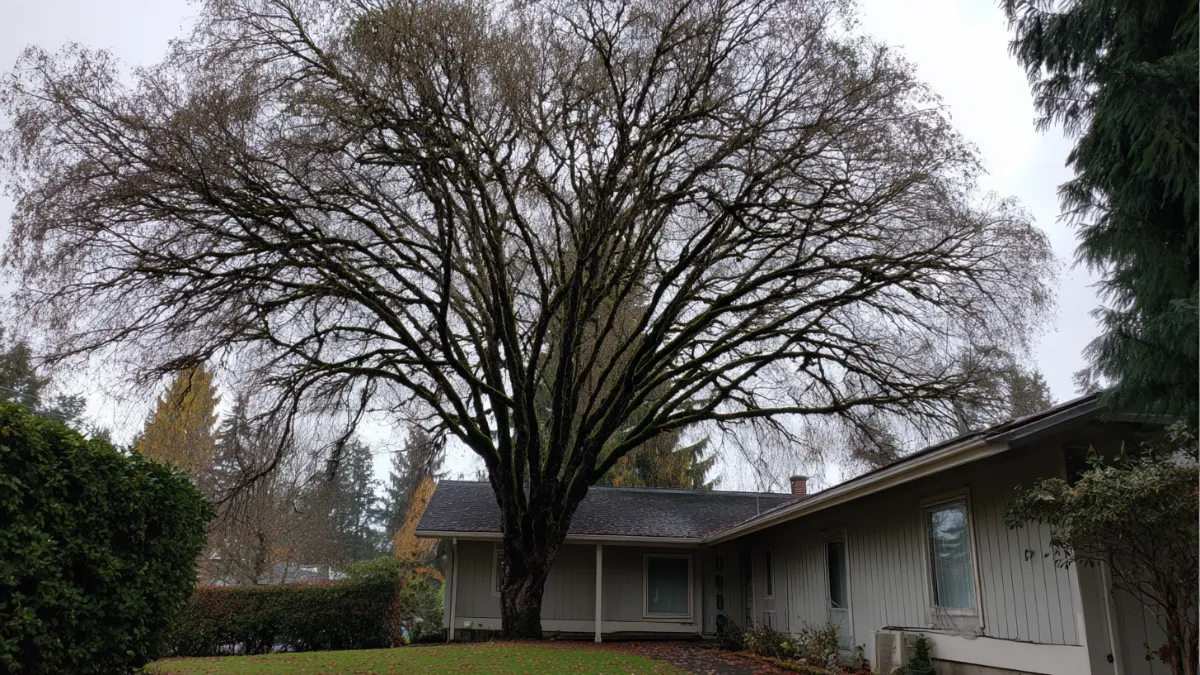
Most trees don't need to come down. They need attention. A maple limb has grown out over the roof, a fir is dropping dead branches on the driveway, the apple tree hasn't been touched in ten years and now it's a thicket. That's trimming and pruning work, and it's most of what a tree crew does in a normal week. We prune trees throughout Skagit County, from windblown yards on the flats near La Conner to the older neighborhoods of Burlington, where street-side maples have been growing toward the wires for decades. Done right, pruning makes a tree safer in a storm, healthier over the long run and better looking the same afternoon. Done wrong, it can ruin a tree in an hour. The difference is knowing which cuts to make and which to leave alone.
This page covers when a tree is due for pruning, the main types of cuts and what they're for, how a pruning visit goes and how often different trees need it. If we get up in the canopy and find something worse than overgrowth, we'll show you photos and talk through whether tree removal makes more sense.
Signs Your Trees Are Due
Dead branches are the first thing to look for. They show up as bare, gray wood in summer, and they're what comes down first in the wind. Limbs resting on or hanging over the roof are next. They scrape shingles, fill the gutters and give squirrels a bridge to the attic. Watch for branches growing into the service line to the house, long heavy limbs reaching sideways over a driveway or play area, and two stems pressed tight together in a narrow V. Fruit trees tell you in their own way: lots of leafy shoots going straight up, not much fruit. And if you can't remember the last time anyone pruned the tree, that's usually your answer.
Crown Cleaning, Thinning, Raising and Reduction in Plain English
Arborists use four main terms, and it helps to know them when you're comparing estimates.
Crown cleaning means removing dead, dying and broken branches. Nearly every tree benefits from it.
Crown thinning takes out selected live branches so light and air move through the canopy.
Crown raising removes the lowest limbs to clear a roof, a driveway or the space under the tree.
Crown reduction shortens the tree's height or spread by cutting limbs back to a smaller side branch that can take over.
What's missing from that list is topping, which means cutting the main trunk or big limbs off flat. Topping starves the tree, invites decay and triggers a flush of weak shoots that break easily later. Mount Vernon's own tree code makes it unlawful on city property and highly discouraged on private land. We don't do it.
How a Pruning Visit Goes
We start on the ground, walking around the tree with you and agreeing on what comes off and why. Then a climber goes up on ropes. We don't use climbing spikes on trees that are staying, because every spike hole is a wound. Cuts are made just outside the branch collar, the slight swelling where a branch meets the trunk, so the tree can seal over the cut. We follow the ANSI A300 pruning standard, and as a rule we take no more than about a quarter of the live canopy in one season. Heavy limbs over a roof get roped and lowered. A typical yard tree takes an hour or two. A big, neglected maple can take most of a day. Brush is chipped and the yard is raked before we go.
How Often Trees Actually Need Pruning
Less often than most people think, and it depends on the tree. Mature firs and cedars mostly look after themselves and need dead wood cleaned out every several years, or after a rough storm season. Bigleaf maples and other broadleaf shade trees do well on a three to five year cycle. Young trees are worth pruning every two or three years while they're small, since shaping good structure early prevents expensive problems later. Fruit trees are the exception. Apples and pears want pruning every year, in late winter before the buds break. For most other trees, the dormant season from late fall through winter is the best window. The leaves are down, the structure is easy to see and the tree is at rest.
If you're not sure whether a tree needs a trim or something more, a hazard tree assessment gives you a clear answer before any cutting starts.
Common Questions
It can, if it's the right kind. Removing dead wood and shortening overextended limbs lowers the odds of branches failing. What doesn't help is stripping out the inner branches and leaving foliage only at the tips, sometimes called lion-tailing. That shifts weight to the ends of the limbs and makes breakage more likely. Heavy thinning of healthy conifers is also oversold. A fir's full crown helps damp its sway. We prune for specific defects and leave the rest.
Usually, yes. Around Anacortes, Bow and the lake properties, view pruning is one of our most common requests. Instead of topping, we use windowing, which removes selected limbs to open a sightline through the tree, and skirting, which raises the lower canopy. Both keep the tree healthy and stable. Trees on shoreline bluffs and steep slopes often have extra rules, and their roots may be holding the bank together, so we check before cutting.
Yes. Skagit has a lot of old apple, pear and plum trees, some left over from farmsteads. An overgrown fruit tree shouldn't be fixed in one go. We bring it back over two or three winters, taking out dead wood and crossing branches first, then lowering the height in stages. Pruning too hard in one season just produces a forest of water sprouts. After that, a light pruning each year keeps it producing fruit you can reach.