
Nobody plants a Douglas fir thinking about the day it has to come down. But trees get old, roots rot, storms take their toll, and sometimes a tree that was fine for fifty years turns into the thing you watch out the window every time the wind picks up. We remove trees all over Skagit County, from big firs on the hillsides above Mount Vernon to tired cottonwoods along the river and cedars crowding houses in Anacortes. Most of these trees can't just be dropped. There's a roof on one side, a fence on another, a drainfield somewhere underfoot and a power line running through the middle of it all. So we take them apart from the top down, one controlled piece at a time, and lower each section on ropes to a spot we picked in advance.
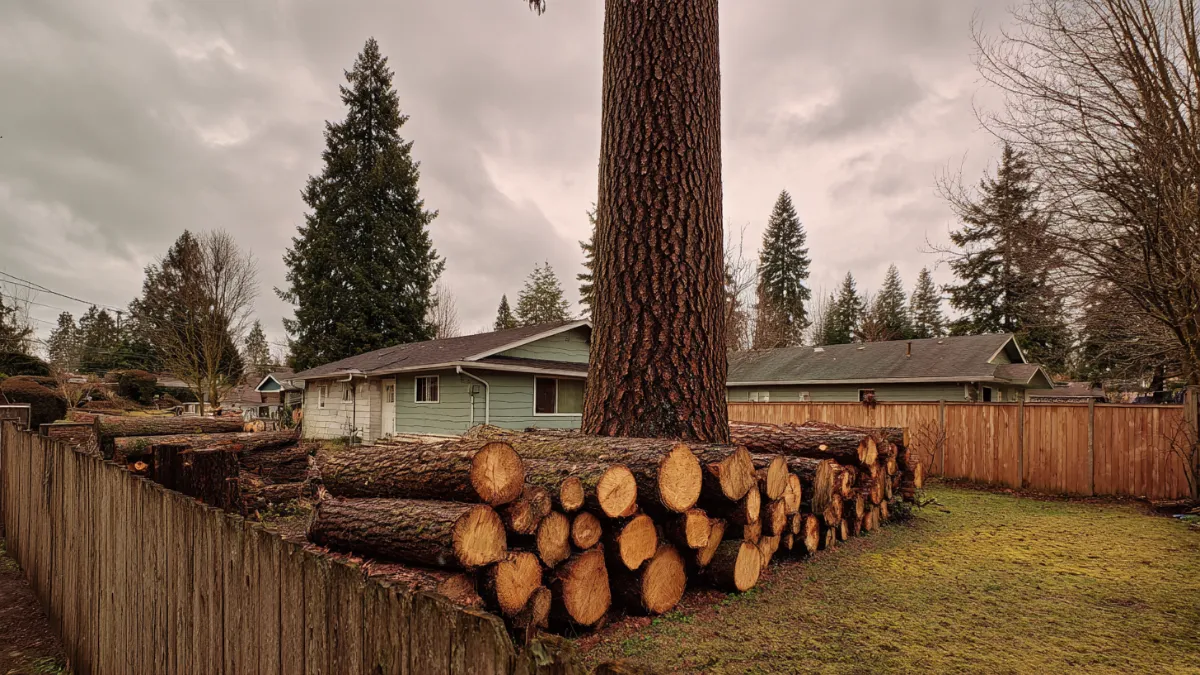
Below, we cover how to tell when a tree needs to come out, why our local species fail the way they do, what a removal day looks like and what to know about permits and insurance. If the tree can be saved, we'll say so. A lot of the removal calls we get end up as a tree trimming and pruning job, and that's a fine outcome.
Signs a Tree Needs to Come Down
Some signs are obvious. The tree is dead, or half the crown is brown in July. Others take a closer look. Mushrooms or shelf-like conks at the base usually mean decay in the roots. A crack running down the trunk, a new lean, or soil heaving up on one side all point to a tree that's losing its grip. On firs, watch the top. A thin, fading crown with a heavy crop of small cones is often a tree under stress. On bigleaf maples, look for large dead limbs and cavities where old branches tore out. One sign alone doesn't always mean removal. Two or three together, on a tree within reach of your house, means it's time to have someone look.
Why Skagit Trees Fail: Root Rot, Wet Soil and Shallow Roots
"The tree looked healthy" is something we hear after almost every blowdown. Often it did. Laminated root rot, a fungus common in Douglas fir across western Washington, eats the roots while the crown stays green, and it spreads underground from tree to tree where roots touch. An infected fir can go over in an ordinary winter storm with hardly any roots left on it. Western hemlock and cedar are shallow-rooted to begin with, and when the soil is saturated from November through March, those roots have less to hold. Red alder and cottonwood are a different story. They grow fast, live short lives and rot from the inside, so a sixty-year-old alder is an old tree. Knowing the species tells us where to look and how the tree is likely to come apart, and that shapes how we rig it.
How We Take a Tree Down
First we walk the site and plan the drop zones, the rigging points and the path for getting wood out. On removal day a climber goes up on ropes, or we bring in a lift when the tree is too far gone to climb safely. Limbs come off first, working from the bottom up. Anything over a roof, fence or garden bed gets tied off and lowered instead of dropped. Then the trunk comes down in sections. On the ground, the crew chips brush as it lands and cuts the wood into rounds. A simple removal takes a few hours. A big fir wedged between two houses can take a full day. When we're done, the stump is cut as low as we can get it and the yard is raked clean.
Permits, Property Lines and Insurance
Whether you need a permit depends on where the tree stands. Each city sets its own rules, and trees near shorelines, streams, wetlands and steep slopes are regulated nearly everywhere in the county. La Conner, for example, has a tree removal permit and counts any tree six inches or more in diameter, measured five feet up, as significant. We check the rules for your address before we schedule. Property lines matter too. If the trunk straddles the line, both owners have a say, so talk to your neighbor first. As for insurance, a policy usually helps when a tree has damaged a covered structure and usually doesn't when a tree is only at risk of falling. We photograph the tree and write up what we find, so you have something solid to hand your adjuster.
Once the tree is down, most people want the stump gone too, and our stump grinding crew can take care of that so the spot is ready for lawn or a new planting.
Common Questions
Piece by piece. We climb the tree, cut it into sections small enough to carry or lower, and move the wood out through a gate. If the gate is narrow, we can take out a fence panel and put it back when we're done. Where there's driveway or street access close by, some jobs call for a crane to lift sections over the house, which is faster and easier on the yard. We work out the plan at the estimate.
Size is only part of it. What drives the price is risk and access: how close the tree is to the house, whether there are wires in the canopy, whether equipment can get near it and how much wood has to be carried out by hand. A dead tree can cost more than a live one because it's less safe to climb. That's why we look at every tree in person before quoting.
Usually not. A sound, well-rooted tree is more of an asset than a threat, and taking trees off the edge of a stand can expose the ones behind it to wind they've never faced. A better first step is an inspection. If the tree checks out, selective pruning to remove dead wood and shorten overextended limbs is often all it needs. We only recommend removal when there's a defect we can point to.