
The call usually comes early in the morning. The wind blew all night, something hit the house around three, and now there's a fir top through the garage roof or a maple lying across the only way out of the driveway. It happens every winter in Skagit County. Storms come in from the south, the Fraser outflow comes down from the northeast, and saturated ground lets go of trees that stood through decades of weather. We handle the aftermath, from blown-down firs in the hills around Sedro-Woolley to snapped limbs on the open flats near Bow and Edison, where gusts have been clocked close to 60 miles an hour. Storm work is the most dangerous kind of tree work there is. Wood under pressure doesn't behave like wood standing in a yard, and a wrong cut can make a bad morning worse.
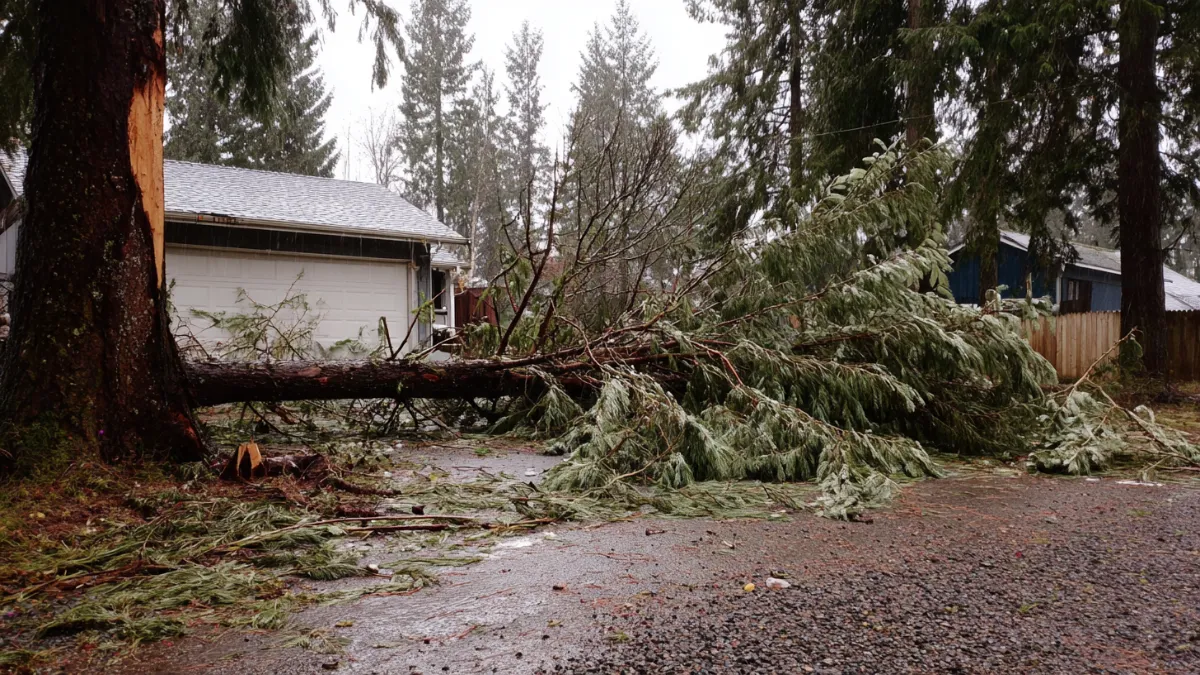
Here's what to do in the first hour, why storm-damaged trees are so hazardous, how we get a tree off a structure and how the insurance side works. And if the storm missed you this time but left you nervous about what's still standing, a hazard tree assessment is the calm-weather way to deal with it.
What to Do First When a Tree Comes Down
Start with people. If the tree hit the house, get everyone out of the rooms under it and keep them out, because the roof framing may be carrying weight it wasn't built for. Look for wires before you go near anything. If a line is down, or the tree is touching one, stay well back and call 911 and Puget Sound Energy. Assume every wire is live. If you smell gas, leave and call from outside. Once everyone is safe, take photos from a distance, as many as you can, before anything gets moved. Then call your insurance company and call us. Hold off on the chainsaw. A lot of storm injuries happen during cleanup, after the wind has stopped.
Tension, Compression and Widowmakers: Why Storm Wood Is Different
A tree that has fallen across something is loaded like a spring. The top side of a bent trunk is stretched tight, which is tension. The underside is being crushed, which is compression. Cut into the wrong side and the saw gets pinched, or the trunk snaps upward or sideways hard enough to break bones. Then there's the root plate. A blown-over tree with its roots tipped out of the ground can stand back up when the weight of the trunk is cut away, and anyone near the hole is in trouble. Overhead, broken limbs hang in the canopy waiting for the next gust. Loggers call them widowmakers for a reason. And a tree leaning into another tree can roll or slide without warning. Reading those forces before the first cut is the whole job.
How We Get a Tree Off Your House
We size up the whole scene before touching it: where the weight is resting, what's holding it and what happens to each piece when it's cut loose. If the tree is on a structure, we often bring in a crane to lift sections straight up and away, so nothing more slides down the roof. Where a crane can't reach, we rig the tree from nearby anchors and lower it in pieces. The parts on the house come off first. Once the weight is off, we can cover the opening with a tarp to keep rain out until your roofer arrives. Then we clear the rest, chip the brush and haul the wood. A single tree across a driveway is often cleared in a couple of hours. A big tree in a roof can take most of a day.
Insurance and Documentation
Homeowners insurance generally covers removing a tree that has damaged a covered structure, like the house, a garage or a fence, along with the repair itself. It usually doesn't pay much, if anything, for a tree that fell in the yard and hit nothing. Policies differ, so read yours or ask your agent. What helps every claim is evidence. We photograph the tree and the damage before, during and after the work. Our invoice separates the cost of getting the tree off the structure from general cleanup, since insurers often treat those differently. Most policies also expect you to prevent further damage, which is why a tarp over the hole matters. Keep receipts for everything.
Some storm-damaged trees can be saved with corrective pruning, and some are too far gone, in which case we'll walk you through a full tree removal.
Common Questions
Not until someone has looked at it. A tree resting on a roof can keep settling for hours, especially if wind or rain continues, and the damage in the attic is often worse than it looks from the ground. Stay out of the rooms beneath it. If the tree came through the ceiling or the walls have shifted, stay somewhere else until the tree is off and the structure has been checked.
Reach out as soon as it's safe and we'll start planning. Climbing or cutting in high wind puts a crew at real risk, so most work waits until the gusts drop. The exception is making a scene safe from the ground, when that can be done without putting anyone under the tree. In a big regional storm, trees on houses and blocked driveways come first, then yards.
Usually more, and it's fair to know why. Storm work is slower and riskier, it often needs a crane, and it tends to happen on nights and weekends. The good news is that when a tree has hit a covered structure, insurance typically pays for the removal. We give you a written price before work starts whenever the situation allows, and we document everything so the claim goes smoothly.