
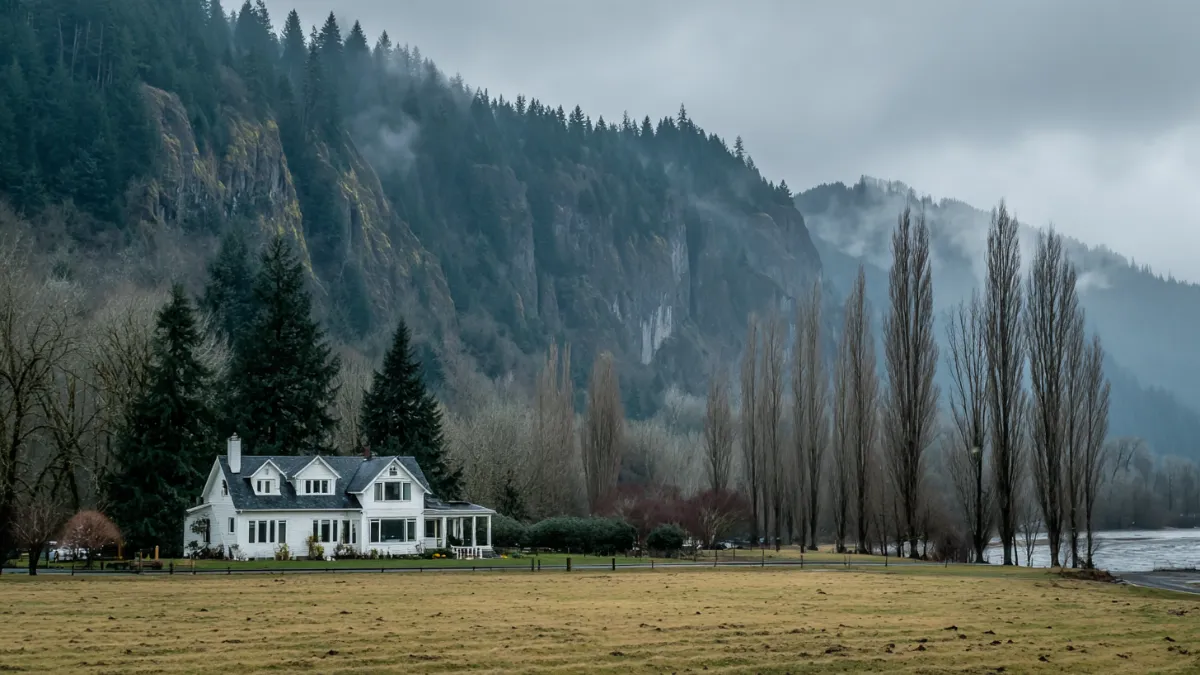
Bow and Edison sit in the windiest corner of the county. To the west it's Samish Bay and open flats. To the north and east, the Chuckanut hills and Blanchard Mountain rise straight up from the farmland, with Chuckanut Drive cut into the slope. Weather comes at this corner from both sides: storms off the water, and cold outflow wind pouring down from the Fraser Valley. In one December storm, gusts in the Bow area reached 59 miles an hour. In another, wind brought power lines down across I-5 near Bow Hill Road and shut the freeway for hours. Trees here live hard lives, and the ones near houses need more attention than they'd get in a sheltered valley.
A good share of our work out here is storm and emergency tree service, followed by stump grinding once the mess is cleared. We also prune and remove trees on the hillside lots above the flats. Call us for a free estimate.
Two Kinds of Country, Two Kinds of Tree Trouble
Down on the Samish flats around Edison, the land is diked delta, flat and wet, with the water table just under the surface. Trees are few: windbreak rows, farmyard maples and poplars, old cottonwoods along the sloughs. They root shallow and take the wind broadside, and when one goes, it usually goes whole. Poplar rows are a common worry. They grow fast, get brittle with age and drop tops and limbs in every storm. Up on Bow Hill and along the Chuckanut slopes, it's the opposite setting: tall fir, cedar and maple on steep ground, often right above a house or a road. There the questions are about the slope as much as the tree. Roots hold these hillsides together, so we think hard before recommending that anything come out, and we often leave stumps in place to keep the bank stable. Waterfront lots along the bay share a lot with the bluff properties in Anacortes.
County Rules and Getting Ready for Wind
Bow and Edison are unincorporated, so there's no city tree code. Skagit County's rules still apply near shorelines, streams, wetlands and steep slopes, which covers a lot of ground out here. In those protected areas and their buffers, the county code allows removal of hazardous, dead or diseased trees that threaten an existing structure or an overhead utility line. That takes written approval from Planning and Development Services first, unless it's an emergency. Away from those areas, fewer rules apply to an ordinary yard tree. Either way, the best time to deal with a risky tree is before November. A pre-winter visit lets us take out dead tops and hanging limbs, shorten overextended branches and flag anything with root or trunk defects. It costs far less than an emergency call, and it's a lot less stressful. The same advice holds for the older neighborhoods in Burlington, a short drive south.
Bow and Edison Tree Questions
It depends on their age and condition. Lombardy and hybrid poplars grow quickly and make a fine windbreak for a few decades, then decline quickly. Once the tops are dying and large limbs are breaking out, pruning only buys a little time. If the row stands near a house, a barn or a power line, staged removal and replanting with longer-lived trees is usually the better investment. If it's out in the open with nothing to hit, it can stand until it falls.
Walk the property in early fall and look up. Dead tops, hanging broken limbs, and branches over the roof or the power drop are the things to fix first. Look down too, for mushrooms at the base and soil lifting around the roots. Have anything questionable inspected before the ground saturates in November. And know where your trees would land. Moving vehicles out from under big trees before a forecast storm costs nothing.