
Conway sits at the bottom of the valley, where the Skagit River splits into its North and South Forks and spreads out toward the bay. Fir Island lies just across the bridge, ringed by dikes, and the land in every direction is flat, rich, wet farmland. Trees here grow in a few places: along the river and the sloughs, around farmhouses and barns, and on Conway Hill to the east, where the ground finally rises and the firs take over. When a windstorm knocks out power in Skagit County, the stretch from Conway up to La Conner is often among the hardest hit. There's nothing between the trees and the weather.
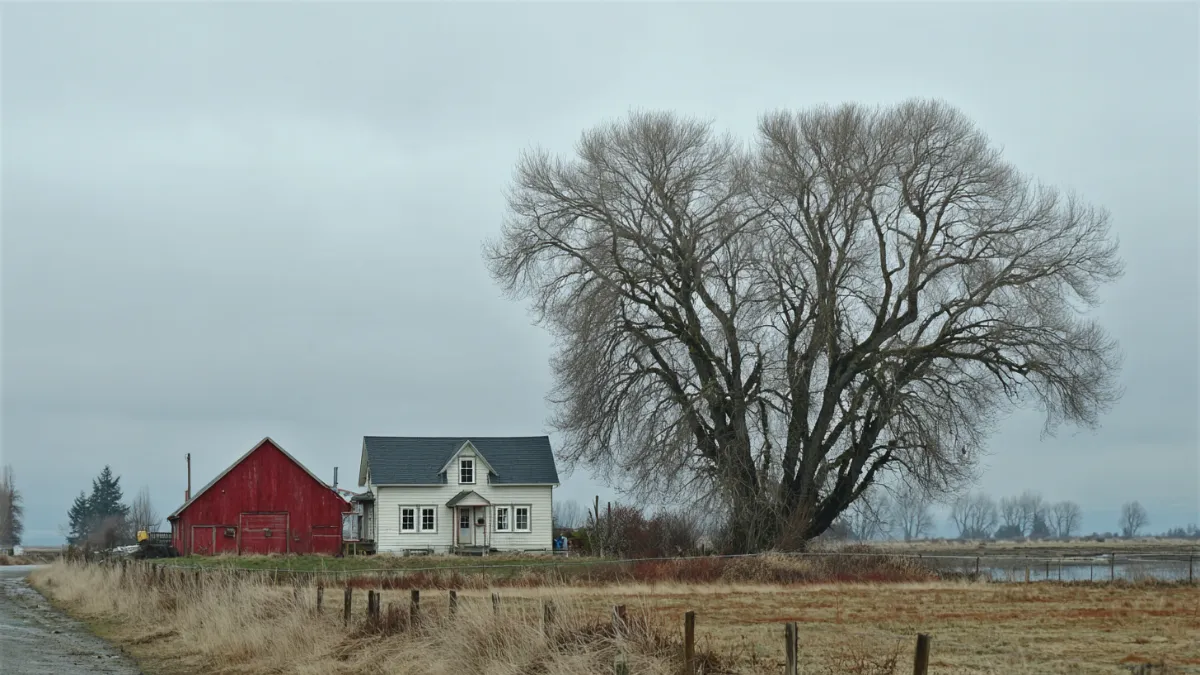
Most of what we do around Conway is tree trimming and pruning on big farmyard trees, and stump grinding where old trees have come out of yards and field edges. We also clean up after storms and take down the cottonwoods that have outgrown their welcome. Call us and we'll come out for a look.
River Cottonwoods and Why They Fail
Black cottonwood is the signature tree of the lower Skagit. It loves river silt and a high water table, and in a good spot it can put on several feet of height a year. That speed comes at a cost. The wood is soft and weak, big limbs rot where they join the trunk, and a mature cottonwood can drop a branch the size of a small tree with no wind at all. By the time one reaches sixty or eighty years, decay is common. Near a house, a shop or a driveway, an old one deserves a hard look every few years. Sometimes reducing the heaviest limbs keeps it safe for another decade. Sometimes the trunk is hollow and the only good answer is to take it down in pieces before it picks its own time. Alders along the sloughs follow the same pattern on a smaller scale. Upstream, the river flats on the west side of Mount Vernon grow the same trees with the same habits.
Dikes, High Water and County Rules
Living on a delta comes with rules about what grows where. Much of the land around Conway lies near the river, a slough or a wetland, and Skagit County's critical areas code protects trees and vegetation in those areas and the buffers around them. The same code makes room for safety. An owner can remove hazardous, dead or diseased trees there when they threaten an existing structure or an overhead utility line, with written approval from the county's Planning and Development Services ahead of time. If the county doesn't answer within 10 business days, the request is treated as allowed, and in a real emergency the tree can come down first with notice afterward. Removed trees are to be replaced with native species within a year. Dikes are their own matter. They're maintained by local dike districts, which often restrict trees on and beside the levee, so ask your district before planting or cutting there. We sort out which rules touch your property before the work starts. Our neighbors across the flats in La Conner have a town permit to deal with on top of all this.
Conway Tree Questions
You often can't tell from looking at the leaves. A cottonwood can be mostly shell and still leaf out fully. Clues include large dead limbs, old wounds where branches tore away, cavities or seams in the trunk, mushrooms or conks on the bark, and carpenter ant sawdust at the base. We sound the trunk with a mallet and, where it matters, probe or drill to measure how much solid wood is left. That tells us whether pruning is enough.
Start with your dike district. The levees around Conway and Fir Island are maintained by local districts, and they commonly limit trees on and near a dike because roots and blowdowns can weaken it. If a tree on your land is close to a levee, ask the district before you plant, prune heavily or remove. We're glad to meet a district representative on site if a tree needs to come out.