
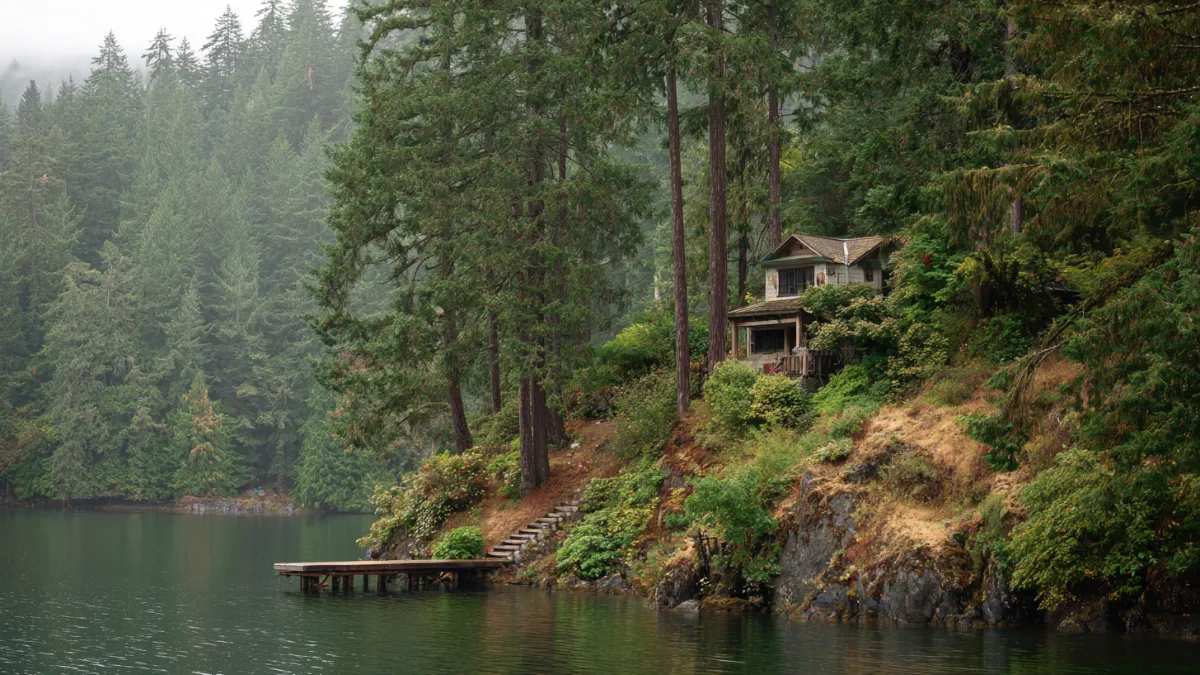
Big Lake is one of the prettiest spots in the county and one of the trickiest for tree work. Houses ring the shoreline along West Big Lake Boulevard and Lake View Boulevard, many of them on narrow lots that drop from the road to the water. Behind them the hills climb steeply, covered in second-growth fir, cedar, hemlock and bigleaf maple. So the typical Big Lake tree is tall, growing on a slope, and standing uphill from a house, a dock or Highway 9. Access is tight. There's often no flat ground to work from and no room to bring equipment close. Most jobs here are climbing jobs, with every piece rigged and lowered by rope.
We do a lot of hazard tree assessment work at the lake, since owners want to know which of the big trees above the house are sound. We also handle tree removal on steep and waterfront lots, where the county has a say in what can be cut. Give us a call and we'll walk your lot with you.
Cutting Trees Near the Water: County Rules at Big Lake
Big Lake is unincorporated, so Skagit County's rules apply, and the important one is the critical areas code. The lake has a protective buffer along its shore, with a standard width of 100 feet, and trees inside it can't just be cleared for a view or a lawn. Hazard trees are treated differently. The county allows an owner to remove hazardous, diseased or dead trees in a buffer when they threaten an existing structure or an overhead utility line. Outside an emergency, that takes prior written approval from Planning and Development Services, and the code says a request that gets no answer within 10 business days is allowed. The cut wood is generally supposed to stay in the buffer, and the owner replants with native species within a year. In a true emergency, the tree can come down first, with notice to the county within one working day. We document the tree's condition so your request is easy to approve. Inside city limits, as in Mount Vernon, different rules apply.
Steep Lots, Tall Firs and Wet Hillsides
The slopes around the lake hold water all winter. Springs and seeps come out of the hillside, and the soil stays saturated for months. Trees rooted in that ground are more likely to tip than snap, root plate and all. On a slope they almost always fall downhill, which is where the houses are. Signs worth watching for are a tree whose lean has changed, fresh cracks in the soil on the uphill side of the trunk, and a curve at the base of the trunk on younger trees, which can mean the slope itself is creeping. Removing trees is not always the safe answer here. Roots knit a hillside together, and a slope stripped of its trees can turn into a slide problem a few years later as the old roots rot. Often the better plan is selective: take the defective trees, keep the sound ones and leave the stumps and roots in place. The same hillside conditions continue north along Highway 9 toward Sedro-Woolley.
Big Lake Tree Questions
Inside the shoreline buffer, generally not by clearing. The county's critical areas rules protect vegetation near the lake, and removing healthy trees there for a view can put you out of compliance. Careful pruning may be an option, such as taking selected limbs to open a window through the canopy. What's allowed on your lot depends on its buffer and any past permits, so check with Skagit County Planning and Development Services first. We can tell you what's realistic when we see the trees.
Not if it's a true emergency. The county code lets an owner act on an unanticipated, imminent threat without prior approval, using the least damaging method, and then notify Planning and Development Services within one working day or as soon as practical. If the tree is a concern but not about to fall, the normal route is a written request, which the code says can't be unreasonably withheld. We'll give you an honest read on which situation you're in.