
Every big tree near a house is a small question mark. Most of them are fine, and will be fine for another fifty years. A few aren't, and the trouble is that the dangerous ones don't always look dangerous. A fir with rotten roots can carry a full green crown. A maple with a hollow trunk can leaf out beautifully every spring. Meanwhile the tree that scares you, the one that sways in every storm, may be perfectly sound, since flexing is how a healthy tree sheds wind. A hazard tree assessment sorts one from the other. We inspect trees for homeowners all over Skagit County, including the tall second-growth firs around Big Lake and the bluff and waterfront properties in Anacortes, where wind and thin soil over rock make every big tree worth knowing well.
This page explains when an assessment makes sense, how arborists rate risk, what we check during a visit and what you can do with the findings. Often the fix is modest. Many trees we look at need nothing more than some trimming and pruning to take out dead wood.
When to Have a Tree Looked At
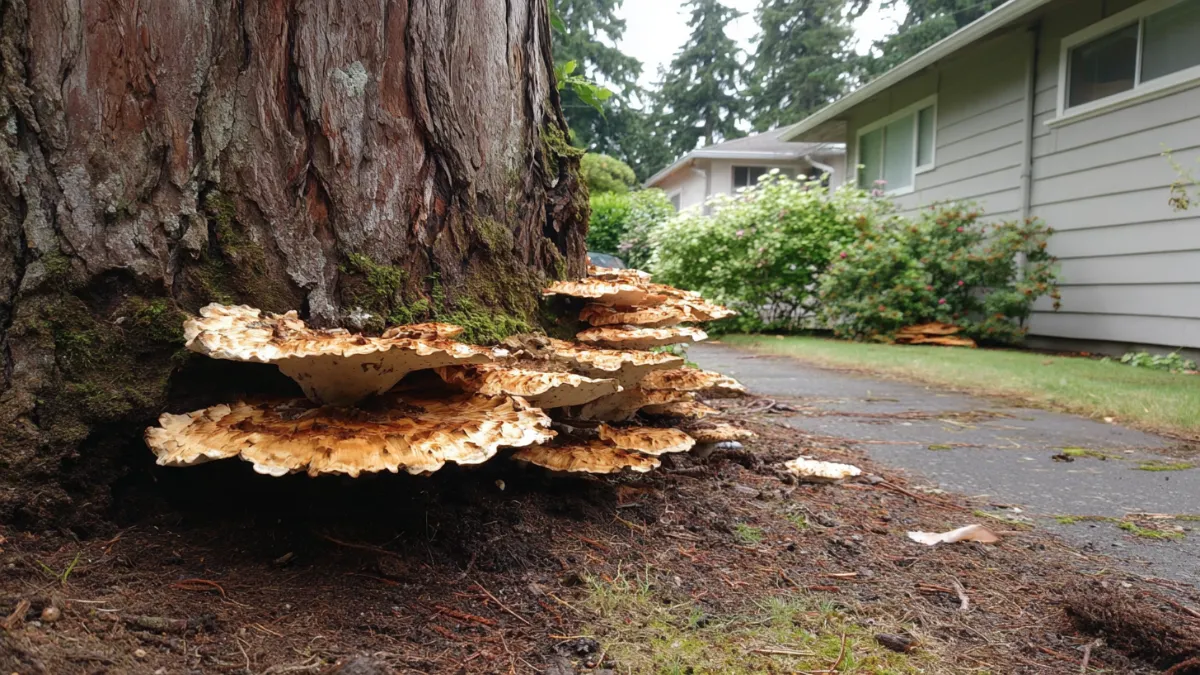
After a big storm is the obvious time, especially if a neighbor's trees came down and yours are the same age and species. Root rot tends to work through a stand in patches. Other good moments: when you're buying a house with large trees, before you build an addition, driveway or drainfield near one, and after any digging that cut through roots. Construction damage can take several years to show in the crown. Changes are worth a call too. A new lean. Cracks in the soil on one side. A dead top. Mushrooms at the base. Bark falling away. A sudden heavy cone crop on a fir. And if a tree has simply been costing you sleep on windy nights, that's reason enough.
How Tree Risk Is Rated
Arborists use a method from the International Society of Arboriculture that weighs three things. First, how likely the tree, or a part of it, is to fail. Second, how likely it is to hit something if it does. Third, how bad the consequences would be. The "something" is called a target: a house, a driveway, a spot where people spend time. This matters because a tree is only a hazard when there's a target. A dying alder at the back of five acres is habitat. The same tree leaning over a bedroom is a problem. The three factors combine into a rating of low, moderate, high or extreme. Most assessments are done from the ground, looking at the whole tree. When something looks wrong, we go further: sounding the trunk with a mallet, probing cavities or climbing to inspect a suspect union up close.
What We Check, From the Ground Up
We start at the roots, since that's where most whole-tree failures begin. We look for heaved soil, fungal conks, cut or girdled roots, and a trunk that enters the ground like a pole with no flare, which often means fill dirt was piled against it. Then the trunk: cracks, cavities, old wounds, bulges, and seams where two stems are pressed together with bark trapped between them. Then the crown: dead tops and branches, thin or off-color foliage, heavy limbs with weak attachments, hangers left from past storms. We also read the site. Has the tree lost its neighbors to clearing, so it's taking wind it never used to? Is the soil saturated or shallow? What would it hit? At the end you get our findings in plain language, with photos.
What You Can Do With the Results
A finding doesn't have to mean a removal. There are usually several ways to bring risk down. Pruning out dead wood or shortening a long limb removes the part most likely to fail. Sometimes the answer is moving the target: shifting a play set or a parking spot out from under the tree costs nothing. Some trees just need watching, with another look after the next storm season. And when a tree in a quiet corner has to come down, it doesn't always need to come all the way down. Left as a trunk fifteen or twenty feet tall, it's no longer a threat to anything, and it becomes a wildlife snag that woodpeckers and owls will use for years. When full removal is the right call, we'll tell you why and show you what we saw.
And if a tree has already failed, skip the assessment and go straight to our storm and emergency tree service.
Common Questions
Start with a friendly conversation. Most people don't know their tree has a problem. If that doesn't work, put your concern in writing and keep a copy. A written notice matters, because an owner who knew about a hazard is generally in a weaker position if the tree later causes damage. For anything beyond that, talk to an attorney. We can assess what's visible from your side of the line, but we can't go onto the neighbor's property or work on the tree without their permission.
Usually not. Swaying is how trees get rid of wind energy, and tall firs can move several feet at the top without any trouble. What deserves attention is movement at the base. If the ground around the trunk lifts, cracks or pumps up and down in the wind, the roots are letting go. That's a reason to call right away and to keep people out of the area the tree could reach.
Yes. You get a written summary of what we found, the risk rating, photos and our recommendation. Homeowners use these for insurance questions, real estate sales, HOA requests and conversations with neighbors. Some cities ask for a formal report from an arborist with specific credentials before they'll approve removing a protected tree. Tell us what it's for, and we'll tell you whether our summary fits or you need that kind of report.